
Explore the concepts, techniques, and case studies in the Kinetic Wave Therapies, LLC equine practice
What to Expect from a Horse & Rider Biomechanics Session blog post 11/12/25

Josie enjoys some cranio-sacral work before her rider mounts up
photo: J. Coates
Horse & Rider Biomechanics sessions focus on the many ways individual asymmetries affect the whole of the equestrian partnership. The initial session builds a foundation for subsequent mounted therapy exercises that continue to enhance the biomechanical health of both horse and human.
To begin, we’ll groom and tack your horse together, assessing any areas of tension around these activities. If necessary, we’ll take time to approach grooming and tacking up in new ways that encourage relaxation and connection. Bodywork and breathing exercises for horse and rider may comprise a portion of this part of the session.
We’ll then gather information through basic groundwork and in-hand exercises that can highlight imbalances in both horse and rider, and also utilize bodywork techniques to support symmetry and partnership.
Once the rider is mounted, there is continued opportunity for bodywork for both partners, depending on where asymmetries are observed. A variety of exercises is also utilized to enhance balance and connection. We’ll work as a team to improve rhythm, suppleness, and impulsion for the horse, based on relaxation, balance, and efficacy of the rider.
As you can see, there is no one-size-fits-all template for these sessions. The intention is always to foster trust and connection between horse and rider; the path to achieve such is individual and complex. This is my passion and my specialty!
Most Horse & Rider Biomechanics sessions are at least 90 minutes. If several people at one location would like to participate, I am available to schedule accordingly and can provide a clinic-style environment so all participants can interact and learn together.
Please contact me to schedule a transformative Horse & Rider Biomechanics session!
The Equine Hyoid Apparatus, part 2: How Osteopathic Care Supports the Hyoid System blog post 10/7/25
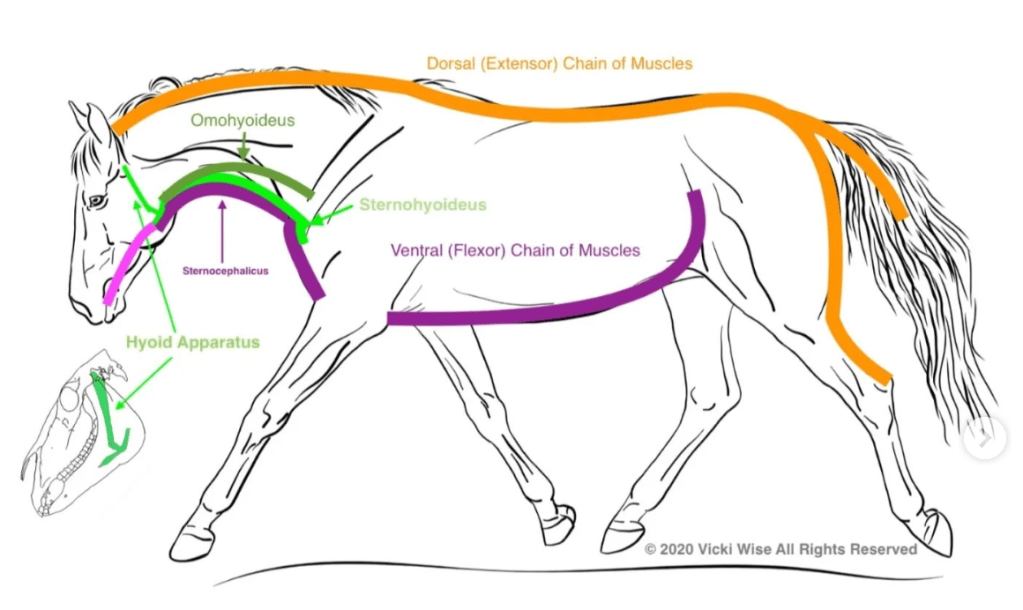
Image via Instagram, copyright Vicki Wise
Osteopathy focuses on the musculoskeletal system, aiming to restore balance and mobility to structures that may be restricted or dysfunctional. When it comes to the hyoid apparatus, osteopathic techniques can address several issues:
- Restrictions in the cervical spine or neck – muscles in these areas can impact the position and function of the hyoid apparatus. Osteopaths use gentle manipulations to enhance neck flexibility, reducing tension around the hyoid area.
- Muscle tension and soft tissue adhesions at the hyoid and omohyoid attachments – tension asymmetries at these attachments can impair the normal movement of the hyoid bones and associated muscles (see Part 1 for details about subsequent system deregulation). Osteopathic techniques help release these restrictions, promoting better function.
- Postural imbalance – painful and/or restrictive musculoskeletal patterns often result in an attempt to regain balance using the hyoid apparatus. Think about how we, as riders, often find our tongue clamped to the roof of our moths when we’re concentrating on a new or difficult maneuver; our horses can experience the same phenomenon. Osteopathic intervention addresses the interwoven nature of all systems in the body, aiming to restore balance and relaxation at certain junctions to affect a wide scope of tissues.
- Gastrointestinal issues – improved functionality in the jaw, tongue, and respiratory structures may allow equines to find relief from low-grade chronic GI woes. Osteopathic support promotes balance and relaxation through these structures, to ease problems chewing, swallowing, and digesting meals and forage.
As with all biomechanical approaches to physiology, there is never only one area on which to focus treatment; the hyoid apparatus, however, may play a role in quite a few solutions. Always consult with your veterinarian to see if Osteopathic care is an appropriate component of your horse’s treatment plan. Contact me if you’d like to discuss hyoid support for your horse.
The Equine Hyoid Apparatus, part 1: Anatomy and Functional Significance blog post 9/4/25

Image via horses and people magazine, copyright Cristina Wilkins
The equine hyoid apparatus, though often overlooked in discussions of equine anatomy, plays a critical role in swallowing, respiration, vocalization, and neuromusculoskeletal integration. Understanding its structure and function provides valuable insight into both clinical practice and performance management.
This suspensory bone structure is situated between the mandibles in the throatlatch region. Unlike most skeletal elements, it does not articulate directly with the skull but is suspended by a network of muscles and connective tissue. The apparatus forms a mobile scaffold that suspends and coordinates the movements of the tongue, pharynx, and larynx.
The equine hyoid apparatus is intimately linked with several muscular systems:
- Suprahyoid muscles (e.g., geniohyoid, mylohyoid, hyoglossus) connect the hyoid to the mandible and tongue, facilitating lingual movement and swallowing.
- Infrahyoid muscles (e.g., sternohyoid, sternothyroid, omohyoid) link the hyoid to the sternum and shoulder fascia, creating functional continuity between the tongue, throat, thorax, and forelimbs.
- Pharyngeal and laryngeal muscles attach to the thyrohyoid and basihyoid, enabling precise coordination of the airway during breathing and deglutition.
Neurologically, the hyoid apparatus is influenced by the hypoglossal nerve (cranial nerve XII), which innervates most tongue muscles, and by branches of the glossopharyngeal (CN IX) and vagus (CN X) nerves, which regulate pharyngeal and laryngeal function. This neuroanatomical integration underscores the role of the hyoid in reflexive and voluntary processes.
How does this apparatus affect equine functionality?
- Deglutition (Swallowing)
- The hyoid apparatus acts as a lever system during swallowing. Movement of the basihyoid and thyrohyoid bones assists in elevating the larynx and closing the airway, while the lingual process anchors the tongue for propulsion of the food bolus.
- Respiration
- The position of the hyoid influences laryngeal aperture and airflow. Dysfunction or asymmetry may compromise upper airway patency, contributing to conditions such as dorsal displacement of the soft palate (DDSP).
- Vocalization
- By suspending the larynx, the hyoid apparatus participates in tension adjustments of the vocal folds. Though horses vocalize less than many species, subtle sound production relies on this mechanism.
- Locomotor Integration
- Fascial and muscular connections from the hyoid to the sternum and scapula link oral function with forelimb and cervical biomechanics. Restriction or asymmetry in hyoid mobility can manifest as resistance in the poll, altered stride mechanics, or compensatory muscular tension along the topline.
How can hyoid dysfunction affect equine performance?
Whether from myofascial tension or bit-related stress, functional restrictions in the hyoid apparatus may present as resistance to contact, difficulty flexing at the poll, or unexplained asymmetry in performance. Hyoid dysfunction may also play a role in pathologies of the GI tract (due to inhibition and/or pain while eating), arthritic conditions (due to prolonged skeletal imbalance caused by improper muscular recruitment), and other physiological systems.
How can bodywork and osteopathic treatment support proper hyoid function?
* Tune in next week for part 2 of this article to find out! * If you just can’t wait, or feel your equine partner might be experiencing some symptoms of hyoid imbalance and would like to discuss, please contact me.
Understanding Postural Muscles in Horses blog post 8/25/25

The illiopsoas muscle group flexes the hip and stabilizes the lumbosacral junction. Josie is in great shape for a senior mare, thanks in part to mindful support for her postural musculature.
photo: J. Coates
When we think of equine athleticism, our minds often go straight to speed, strength, and agility. Yet, behind every graceful stride and powerful jump lies a foundation built on postural muscles. These muscles, often overlooked, play a vital role in a horse’s balance, movement efficiency, and long-term soundness.
What Are Postural Muscles?
Postural muscles are the deep, stabilizing muscles that help a horse maintain alignment and posture, even when standing still. Unlike larger “performance muscles” (like the gluteals or hamstrings), which generate locomotion, postural muscles provide endurance and stability. They support the spine, pelvis, and limbs, allowing the horse to carry itself correctly and move with ease.
Key Postural Muscle Groups in Horses
- Core Muscles – Including the multifidus, longissimus dorsi, and abdominal muscles, these stabilize the spine and support collection and self-carriage.
- Neck Muscles – Such as the splenius and longus colli, which balance the head and neck, are essential for proper rein contact and posture.
- Pelvic and Hip Stabilizers – The iliopsoas and deep gluteal muscles, which align the pelvis and help absorb shock.
- Thoracic Sling Muscles – Including the serratus ventralis, which suspend the ribcage between the forelimbs and play a major role in shoulder freedom.
Why They Matter
Healthy postural muscles help horses:
- Maintain proper alignment, reducing strain on joints and ligaments.
- Develop balance and rhythm under saddle.
- Achieve collection, extension, and lateral work with less resistance.
- Prevent back pain, kissing spine, and compensatory injuries.
When postural muscles are weak, horses often rely too heavily on larger, movement-based muscles. This can lead to stiffness, hollow backs, or difficulty engaging the hind end.
Supporting Postural Health
Developing strong postural muscles requires consistency and patience. Riders, trainers, and bodyworkers can support equine posture through:
- Correct, Gymnastic Riding – Encouraging relaxation, engagement, and gradual collection.
- Groundwork & Pole Work – Activities like long-reining, hill work, and cavaletti build core strength.
- Bodywork & Therapy – Massage, osteopathy, and structural integration can release tension and rebalance muscle use.
- Proper Saddle Fit – A well-fitted saddle prevents pressure points and allows free movement of the back and shoulders.
The Bigger Picture
Strong postural muscles are not just for high-performance horses—they’re vital for all equines, from companions to athletes. By paying attention to these deeper stabilizing structures, we promote healthier biomechanics, better performance, and improved comfort for our horses.
– Postural Release and Structural Integration, An Holistic Approach to Lasting Alignment Blog post 7/27/25

photo: J. Coates
When postural release and structural integration techniques are used in tandem, they create a powerful synergy supporting deep healing, improved posture, and overall body balance. While each approach has its own methods, their combination can enhance their individual effects, blending subtle nervous system regulation with strategic musculoskeletal alignment.
Postural release focuses on gentle, passive techniques that allow the body to unwind habitual tension patterns. These methods calm the nervous system and invite tissues to release naturally, often through supported positioning, light pressure, or guided movement. This prepares the body for deeper structural changes without resistance.
Structural integration, by contrast, works more actively with the fascia—the connective tissue network that holds the body’s shape. Through hands-on techniques and a systematic approach to realigning the body with gravity, it restores balance and ease in posture and movement.
Together, these techniques address both the soft tissue restrictions and the underlying neuromuscular patterns that keep the body out of alignment. Postural release sets the stage for deeper fascial work, while structural integration anchors those changes by organizing the body’s structure more efficiently.
Horses, like people, can develop postural imbalances from training, injury, poor saddle fit, or habitual movement patterns. These imbalances often lead to compensation, tightness, or uneven muscle development. Postural release combined with structural integration addresses these issues by gently realigning the body, releasing tension, and restoring natural balance through a series of sessions that target different areas of the body.
The benefits are both physical and behavioral. Horses may show increased range of motion, improved stride quality, and reduced soreness or stiffness. Many owners also notice their horses becoming more relaxed, focused, and responsive under saddle. In performance horses, these combined techniques can help maintain optimal neurobiomechanics, prevent injury, and support recovery between competitions.
Overall, bodywork utilizing postural release and structural integration offers an holistic, non-invasive way to enhance equine health and performance, helping horses move with greater ease, confidence, and comfort throughout their lives.
 shannonrunkelmt.com